The diary, across sites
One diary per practice, not one per surgery. Chairs, providers and opening hours are set per site, and a booking made at reception is on the screen in the other building.
Diary, charting, billing and claims on one patient record — across every site the practice runs.
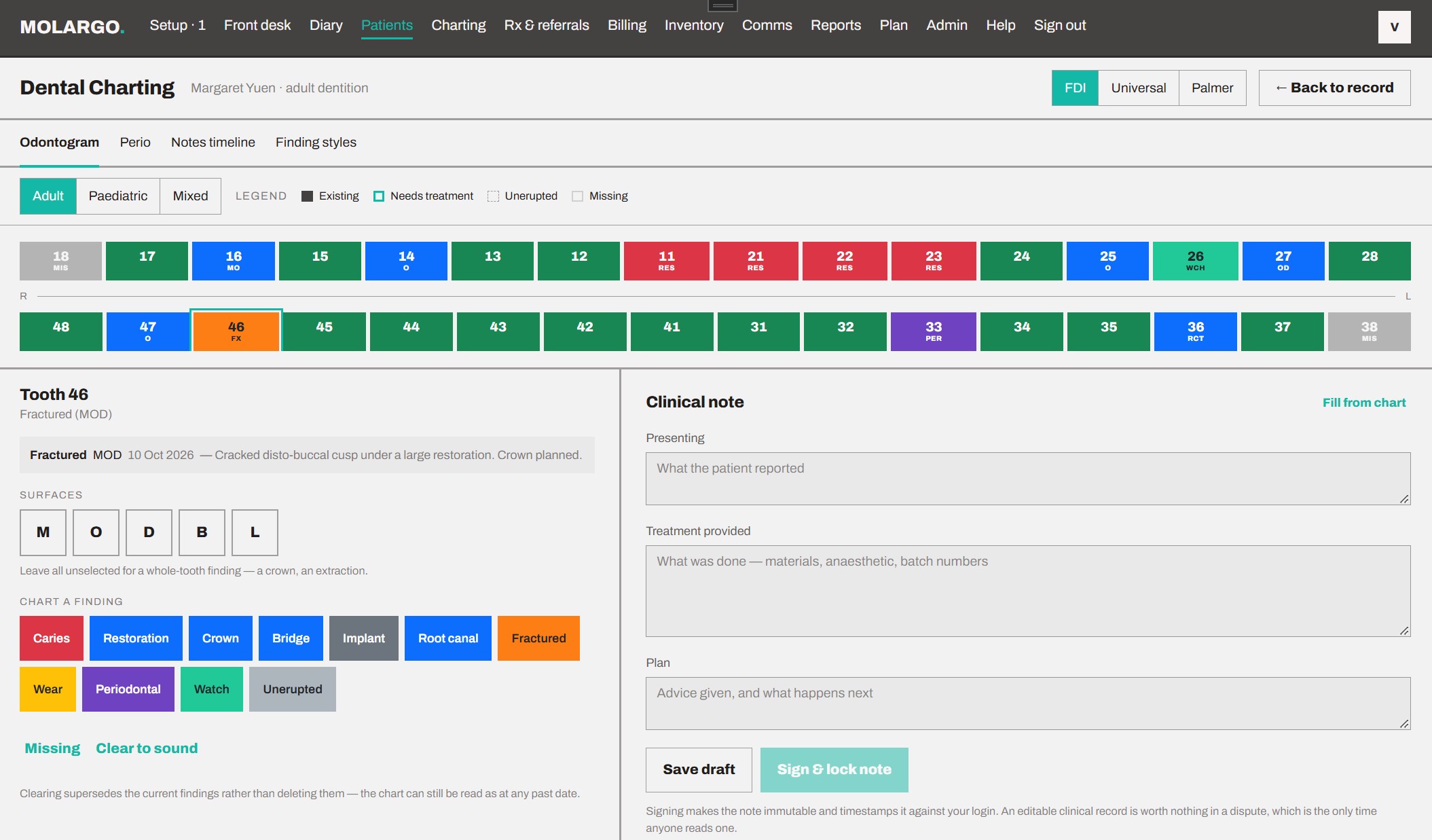
Alerts at the top where they interrupt, treatment plans with their value and gap, the balance, and the history underneath.
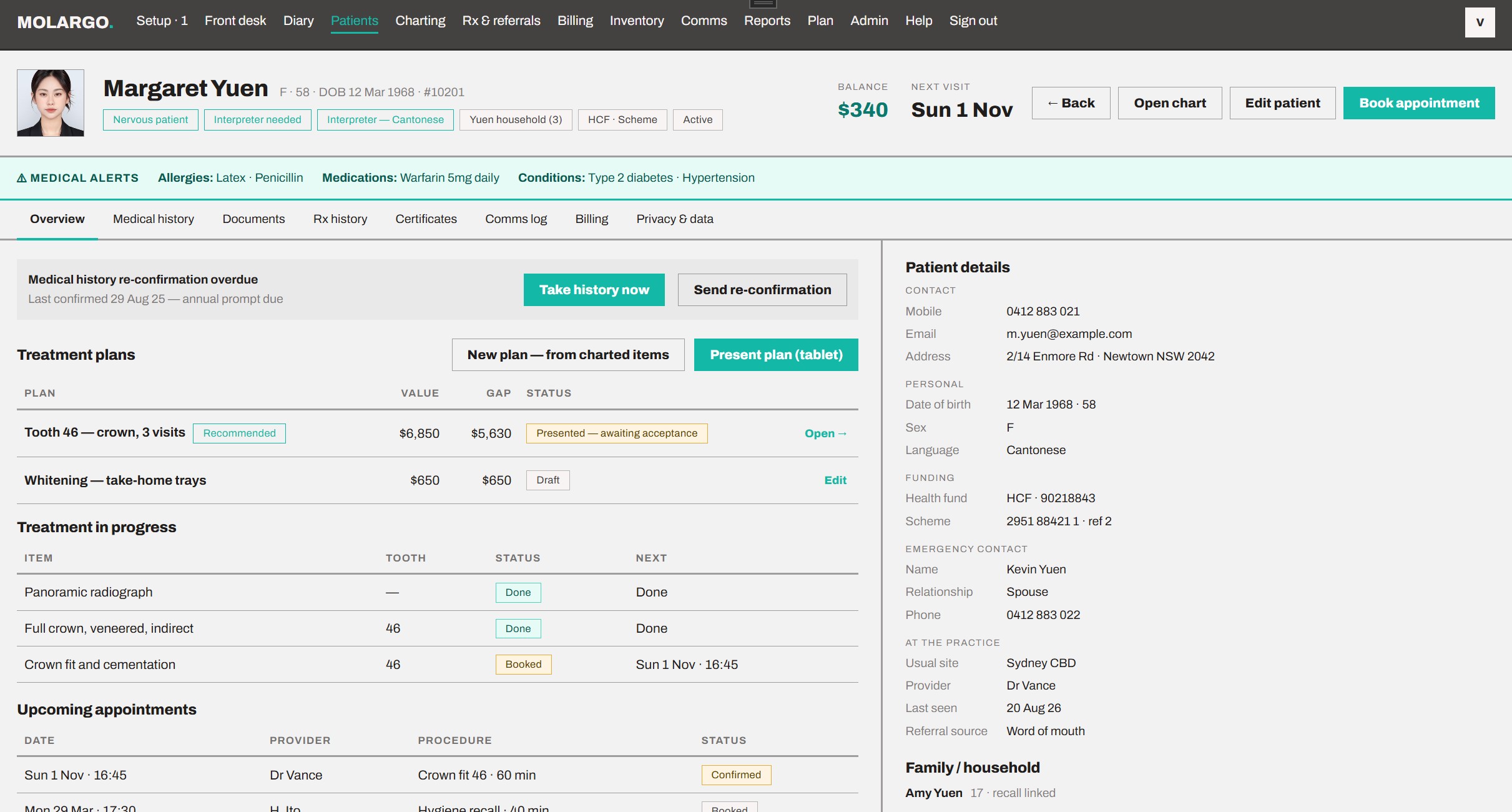
What is booked, what is unpaid, what did not turn up — and the tasks and short-notice list right there to act on.
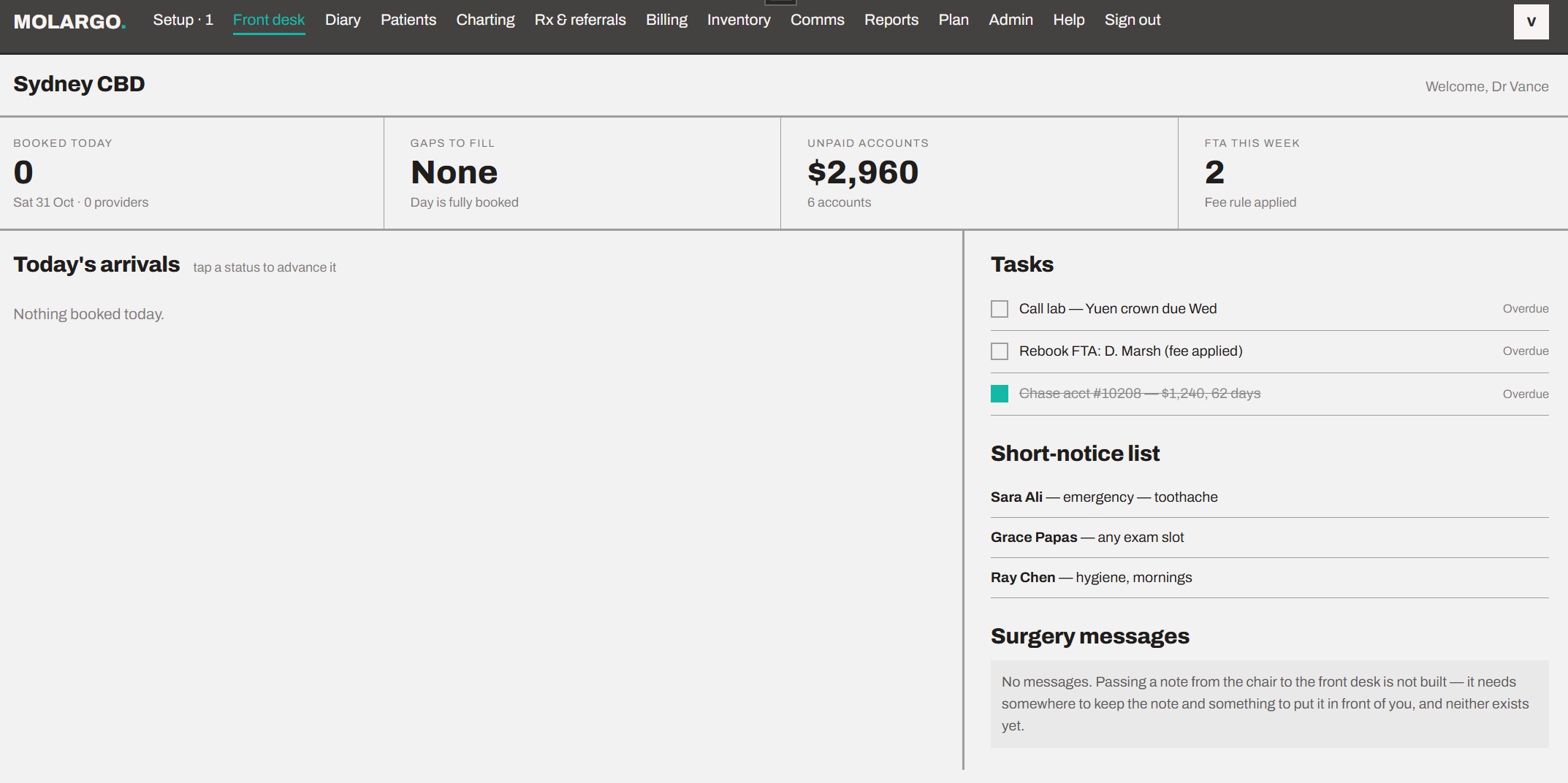
One codebase behind all three, so a change reaches every device at once rather than one platform at a time.
Chairside and at reception — the one most practices put in the surgery.
The same app and the same screens. Nothing held back for one platform.
For the front desk and the back office, where the day is run from a keyboard.
Molargo also runs in a browser, which is the quickest way to try it without installing anything.
Every module writes to the same patient record and the same audit trail. Nothing is bolted on, and nothing needs exporting to reach the next step.
One diary per practice, not one per surgery. Chairs, providers and opening hours are set per site, and a booking made at reception is on the screen in the other building.
Identity, contact, funding and consent on a single record with a duplicate check on save. Households link members so a family is booked and billed together.
Odontogram, six-point perio charting and a visit note that locks when it is signed. Supersedings are kept rather than overwritten.
A formulary behind every script, referral letters in both directions, and a prescription history that stays attached to the patient rather than the prescriber.
An item catalogue priced per site, tax handled per country, and invoices that keep the fee as charged. Payments route to the provider for the plan's own currency.
Stock per site with purchase orders behind it, and lab cases tracked from impression to fit with the docket on the patient.
Reminders and recalls over SMS and email, sent through the practice's own accounts. Marketing consent is held separately from operational consent, because they are not the same permission.
Radiographs, photographs, consents and reports filed against the patient. Uploads are checked by signature rather than file name, and stored under a key scoped to the practice.
Per-person accounts with two-step sign-in, roles deciding who may author clinical records, and an audit entry for every write — including every time a stored document is opened.
Molargo is the software a dental practice runs on. The practice is the custodian of its patients' records; we hold them on its behalf and process them only to run the service.
Draft — not yet legal advice or a binding policy. This describes how the software behaves today. It has not been reviewed by a lawyer and does not yet address the specific obligations that apply in each country Molargo is sold in.
Health information is separately regulated under the Privacy Act 1988 and the Australian Privacy Principles, New Zealand's Privacy Act 2020 and Health Information Privacy Code, UK GDPR, and the Philippines Data Privacy Act 2012. Have this reviewed against each before you publish it.
The practice decides what goes into its records and who may see them. Molargo provides the system, keeps it running and keeps it separated. We do not use patient data to train anything, sell it, or share it outside the practice except where the practice asks us to or the law requires it.
Every record carries the practice it belongs to, and every read is filtered on it before it reaches the database. A request that has not resolved a practice matches no rows at all rather than matching everything — failing closed, because the alternative turns one bug into a cross-practice disclosure.
Patient files are stored under a key beginning with the practice's own identifier, so a practice's documents can be exported, moved or erased as a unit.
A photograph taken on a phone carries GPS coordinates, the device's serial number and a timestamp. Molargo strips that metadata when the photo is stored, after using the orientation tag to turn the picture the right way up. Uploads are identified by their contents rather than their file name, and anything outside the accepted formats is refused before it is written.
Clinical records are retained, not erased, because they are the evidence of care — retention periods are set by law in each country and are the practice's to meet. Deleting a document is the deliberate exception: the row is kept and the bytes are removed, because a file the practice believes it has deleted and has not is a privacy problem rather than a retention one.
Passwords are stored hashed and are never recoverable. Card details are never held by Molargo — payment pages belong to the payment provider, and we keep only what is needed to recognise a payment against a bill.
If you are a patient, your record belongs to your dental practice — ask them, and they can produce or correct it. If you are a practice and need an export, an erasure or an answer about an audit entry, contact support.
A subscription to run your practice on Molargo, billed monthly, with what you pay decided by the plan you are on and the size of the practice on it.
Draft — not yet a contract. This sets out how subscriptions behave in the product. It has not been through legal review and does not yet carry the clauses a software agreement needs: liability, warranties, governing law, dispute resolution, or the processing terms a practice's own privacy obligations depend on.
Plans are priced per country, in that country's currency, and a practice buys the plan sold where it operates. Each plan covers a number of sites and a number of clinical seats per site.
Subscriptions are billed monthly. Changing plan takes no payment at the time it is made — the change is recorded and audited, and the next charge uses the new plan. Nothing is charged during a trial.
Patient records, documents and the audit trail belong to the practice. We hold them to run the service and will produce an export on request. Ending a subscription does not forfeit them.
A suspended practice cannot sign in; its records are kept, not deleted. Suspension is for unpaid bills or misuse, never a way to withhold a practice's records from it.
Molargo records clinical decisions; it does not make them. It does not diagnose, does not prescribe on its own, and does not replace a clinician's judgement or a practice's obligation to meet the standards it is regulated against.
Most questions are about a setting rather than a fault, and those are answered the same day. Anything that stops a surgery working is treated differently.
The usual way in. Include your practice's sign-in code and, if it is about one record, the patient number rather than the name.
support@molargo.comFor anything that stops the practice working — the diary, sign-in, or a surgery that cannot chart.
Add your support numberHelp sits in the main navigation, alongside the audit log where you can see exactly what changed and who changed it.
Help & audit logBefore you write in, two things save a round trip.
Your practice's sign-in code, and the date and time the problem happened — the audit log is keyed on both, and with them we can usually tell you what happened rather than ask you to reproduce it. Never send patient names, dates of birth or clinical details by email; a patient number is enough for us to find the record.